The 1970s Office Worker Clocked Out at 5 and Disappeared. We're Still Trying to Figure Out How They Did It.
The 1970s Office Worker Clocked Out at 5 and Disappeared. We're Still Trying to Figure Out How They Did It.
Somewhere around 5:15 on a Tuesday in 1973, a mid-level accountant at a manufacturing firm in Cleveland gathered his papers, put on his coat, and walked out of the office. He did not check his phone on the train home. He did not log back in after dinner to answer emails. His boss had no way to reach him until 8:30 the following morning, and — crucially — didn't expect to.
He was just... gone. Unavailable. Off the clock in a way that was total and unremarkable and completely normal.
That kind of clean break between work and life has become so rare in modern America that it almost sounds like a fairy tale. But for the majority of office workers in pre-digital America, it was simply Tuesday.
What an Office Actually Looked Like in 1970
To understand how differently work functioned, you have to start with the physical reality of the space.
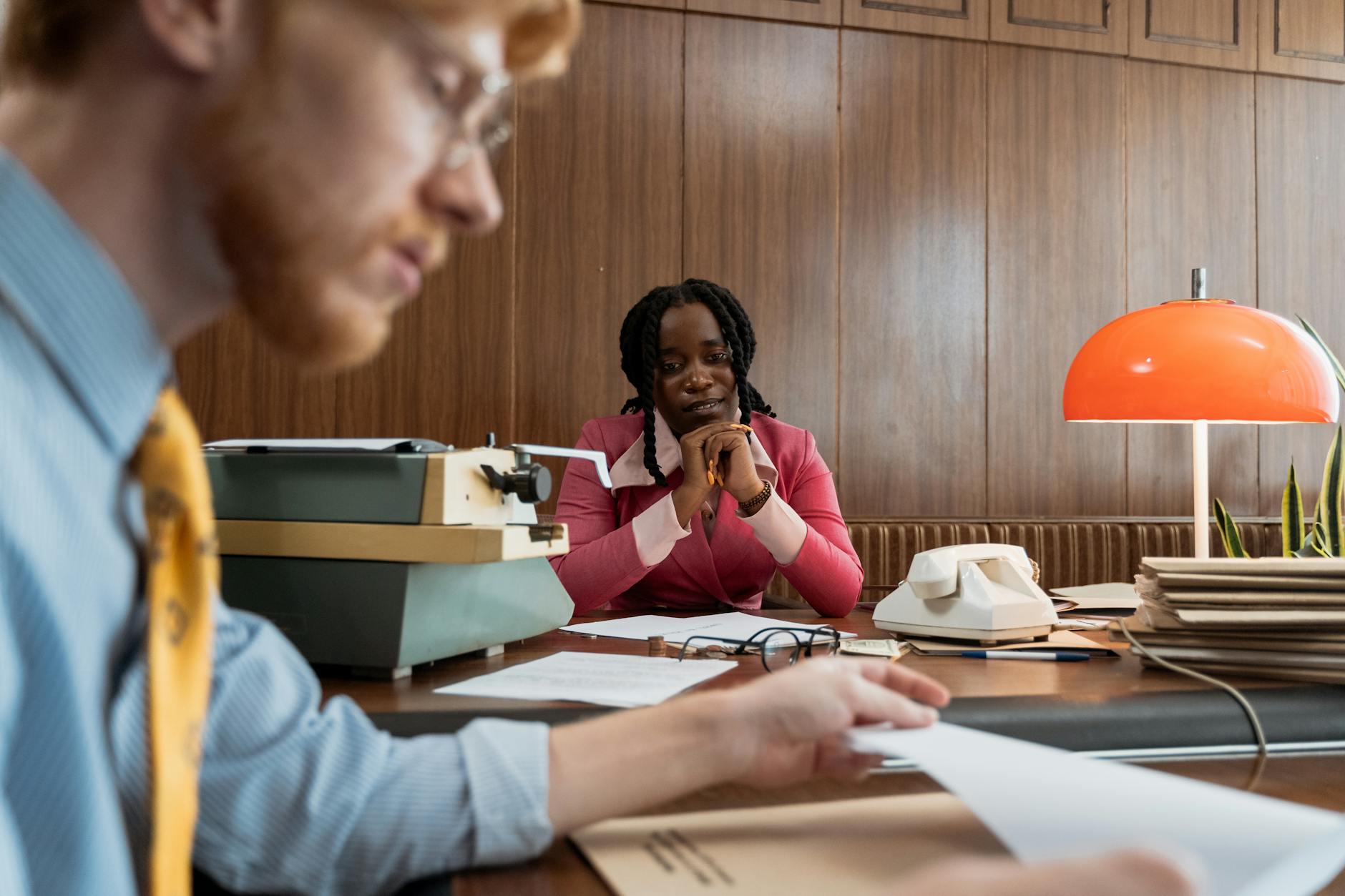
The typical American office in 1970 was a paper-based ecosystem of considerable complexity. Accountants maintained ledgers by hand — actual books, updated with actual pens, balanced with actual arithmetic. Correspondence was typed on electric typewriters, with carbon paper inserted between sheets to produce copies. If you needed three copies of a memo, you typed the memo once with three sheets of paper and two sheets of carbon paper sandwiched between them. If you made a mistake on page two, you corrected all three copies individually.
Outgoing mail went to the mailroom — a physical department staffed by actual people whose entire job was sorting, routing, and dispatching paper. Internal memos traveled through pneumatic tube systems in larger buildings, or were hand-delivered by messengers. A document sent from New York to a client in Chicago arrived in two to three days. Everyone understood this. Deadlines were set accordingly.
The telephone existed, of course, but long-distance calls were expensive and somewhat formal — not something you made casually. Many offices employed switchboard operators or receptionists who managed incoming calls and physically connected them to the right desk. If someone wasn't at their desk, there was no voicemail. The caller would simply try again later.
The Rhythm of a Day Without Notifications
Work in 1970 had a texture that's genuinely hard to imagine from the vantage point of a modern open-plan office with Slack running in one tab and three browser windows open.
Tasks were largely sequential rather than simultaneous. You finished one thing, then started the next. Interruptions existed — a colleague stopping by your desk, a phone call, a supervisor dropping off a file — but they were discrete events with clear beginnings and ends, not the ambient, continuous drip of digital notifications that characterizes modern knowledge work.
Meetings happened, but far less frequently than today, and they tended to be shorter. Without presentation software, slide decks, or screen-sharing, meetings were fundamentally verbal — someone talked, people took notes by hand, decisions were made, the meeting ended. The average worker in 1970 wasn't spending 30 percent of their week in video calls with colleagues they'd never met in person.
Lunch was genuinely a break. Workers left the building, went to a diner or a cafeteria, and returned. There was no such thing as eating at your desk while answering emails, because there were no emails to answer.
And at five o'clock, the day ended. Not metaphorically — literally. You left. The office closed. The work waited until tomorrow.
What Changed, and When
The transformation didn't happen overnight. It accumulated gradually across several decades, each new tool adding a layer of accessibility and expectation.
The fax machine, widely adopted through the 1970s and 80s, was the first crack in the wall — suddenly documents could arrive instantly, and urgency crept into business communication in a new way. The answering machine extended the workday slightly, making it possible to leave and receive messages outside office hours.
Then came the personal computer, which arrived on office desks through the 1980s and fundamentally changed the nature of clerical and administrative work. Tasks that once required specialized skills — typesetting, complex calculations, filing — became things anyone with a computer could handle. Productivity soared. So did expectations.
Email arrived in mainstream American offices in the early 1990s and rewired everything. Correspondence that once took days now took seconds. The volume of communication exploded. And with it came the first serious erosion of the boundary between work time and personal time — because email didn't care what hour it was.
The smartphone, arriving in earnest in the late 2000s, finished the job. Work was now in your pocket, always. Your boss could reach you on a Sunday afternoon. You could check your work inbox at your kid's baseball game. The physical act of leaving the office no longer meant anything in particular.
The Trade-Off Nobody Fully Agreed To
It's worth being honest about what the pre-digital office was not. It was frequently rigid, hierarchical, and exclusionary in ways modern workplaces have genuinely improved upon. Remote work was impossible. Flexibility was minimal. Women and minorities faced structural barriers that the old office culture actively maintained. The nostalgia for a cleaner separation between work and life shouldn't be confused with nostalgia for everything else that came with it.
But something real was lost in the transition, and American workers are increasingly aware of it. The concept of "work-life balance" didn't need to exist as a named aspiration in 1970, because the structure of work enforced it automatically. You didn't need a digital detox because there was nothing to detox from. The boundaries were architectural and technological, not personal and negotiated.
Today, millions of American workers carry their offices in their pockets and their jobs in their heads, 24 hours a day. We are more connected, more productive by many measures, and more flexible in how and where we work. We are also, by most available evidence, more stressed, more burned out, and less certain where work ends and life begins.
The man who walked out of that Cleveland office at 5:15 in 1973 didn't think of himself as having something precious. He was just going home.
We're still trying to figure out how to do the same.