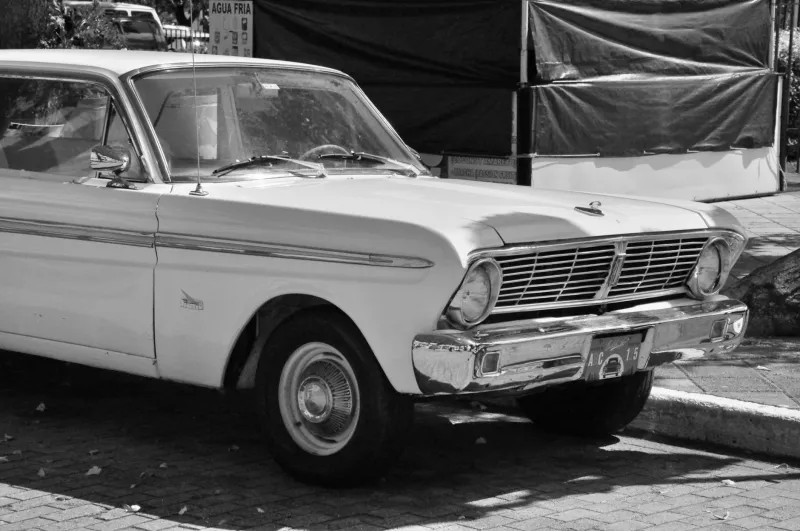
The Ritual That Defined American Weekends
Every Sunday after church and dinner, the Johnson family from Toledo would pile into their 1963 Buick Skylark. Dad behind the wheel, Mom in the passenger seat with a thermos of coffee, kids arguing over window seats in the back. They had no particular place to go—and that was exactly the point.
The Sunday drive wasn't just transportation. It was America's favorite hobby.
From the 1920s through the 1970s, millions of American families participated in this weekly ritual. You'd cruise through neighborhoods you'd never seen, wave at strangers on their porches, stop at roadside stands for fresh corn or ice cream, and maybe discover a new lake or scenic overlook. The car was your living room on wheels, and the open road was your entertainment.
When Cars Were Still Magic
To understand the Sunday drive, you have to remember when owning a car felt like owning a piece of the future. In 1950, only 59% of American households had automobiles. By 1970, that number jumped to 83%, but cars were still special enough that taking one out for pure pleasure felt like a luxury worth savoring.
Gasoline cost around 27 cents per gallon in 1960—about $2.70 in today's money. A tank of gas that could take you 300 miles cost less than a movie ticket for the whole family. The economics made sense: why stay home when adventure was so affordable?
Families would spend entire afternoons "going for a ride." They'd explore the expanding suburbs, drive past new construction sites, and marvel at how quickly their world was changing. The Sunday drive was both escapism and education—a way to see how other people lived without the commitment of actually visiting them.
The Death of Aimless Adventure
Several forces conspired to kill the Sunday drive, but the 1973 oil crisis delivered the fatal blow. Gas prices quadrupled almost overnight. Suddenly, driving for pleasure felt wasteful, even unpatriotic. President Nixon asked Americans to reduce their driving, and the Sunday drive became an early casualty of conservation.
But economics alone didn't end the tradition. American life was restructuring itself in ways that made aimless driving feel obsolete. Suburban sprawl meant you had to drive farther to find anything interesting. Shopping malls replaced Main Street as destinations worth visiting. The interstate highway system, designed for efficiency, bypassed the scenic routes that made Sunday drives special.
When Entertainment Moved Indoors
The rise of cable television offered 50+ channels of programming, making the couch more appealing than the car. Video games arrived in the late 1970s, giving kids something more engaging than staring out windows. Air conditioning became standard in homes, eliminating the need to seek cool breezes on the road.
By the 1980s, American families were scheduling their leisure time differently. Soccer practices, piano lessons, and organized activities replaced spontaneous adventures. The idea of spending three hours driving nowhere specific started to feel like poor time management rather than quality family time.
What We Lost When We Stopped Wandering
The Sunday drive represented something uniquely American: the belief that the journey could be more important than the destination. Families talked differently when trapped together in a car for hours with no agenda. Kids learned geography by watching it roll past their windows. Parents shared stories about their own childhood drives.
These trips taught patience in ways our current culture struggles to replicate. You couldn't fast-forward through the boring parts or skip to the good stuff. You learned to find interest in ordinary landscapes, to appreciate the subtle differences between one small town and another.
The Sunday drive also democratized exploration. You didn't need special equipment, expensive tickets, or advance reservations. Any family with a car and a few dollars for gas could be tourists in their own region.
The Modern Equivalent That Isn't Quite the Same
Today's closest equivalent might be the scenic route suggested by GPS apps, but these experiences are fundamentally different. Modern road trips are typically planned, photographed, and shared on social media. We drive to specific Instagram-worthy locations rather than simply driving to see what we might find.
Some families still take Sunday drives, but they're often punctuated by phone calls, navigation prompts, and requests to "look this up." The meditative quality of pure movement has been replaced by the anxiety of constant connectivity.
The Economics of Modern Leisure
Gas prices averaging over $3.50 per gallon make recreational driving expensive. A three-hour Sunday drive now costs $15-20 in fuel alone—about the same as a Netflix subscription that provides a month of entertainment. The math no longer favors the open road.
Modern cars, while more efficient, feel more like computers than mechanical companions. The romance of the automobile has been replaced by the practicality of transportation. We optimize our routes, track our mileage, and treat driving as a necessary evil rather than a potential adventure.
What Sunday Drives Taught Us About America
The Sunday drive reflected an America that still believed in serendipity, in the value of unstructured time, and in the possibility that the most memorable moments might happen when you weren't trying to create them. It was a weekly reminder that home was just the starting point, not the destination.
These drives also revealed how much the country was changing in real-time. Families witnessed suburban development, highway construction, and the gradual transformation of rural America into something else entirely. The Sunday drive was both escape from change and front-row seat to it.
When we stopped taking Sunday drives, we lost more than a hobby. We lost a shared ritual that taught us how to be curious about our own neighborhoods, patient with each other's company, and satisfied with entertainment that didn't require a screen or a schedule. In our rush to get somewhere faster, we forgot how good it felt to go nowhere in particular.