Your Corner Pharmacist Knew Three Generations of Your Family. Now a Robot Counts Your Pills.
When Your Pharmacist Was Part of the Family
Walk into any chain pharmacy today, and you'll likely encounter a drive-through window, automated dispensing machines, and a technician who asks for your date of birth to locate your prescription in the computer system. It's efficient, sanitized, and completely anonymous. But step back fifty years, and the American pharmacy was an entirely different institution—one where the pharmacist knew not just your name, but your grandmother's heart condition, your father's bad back, and exactly which cough syrup worked best for your kids.
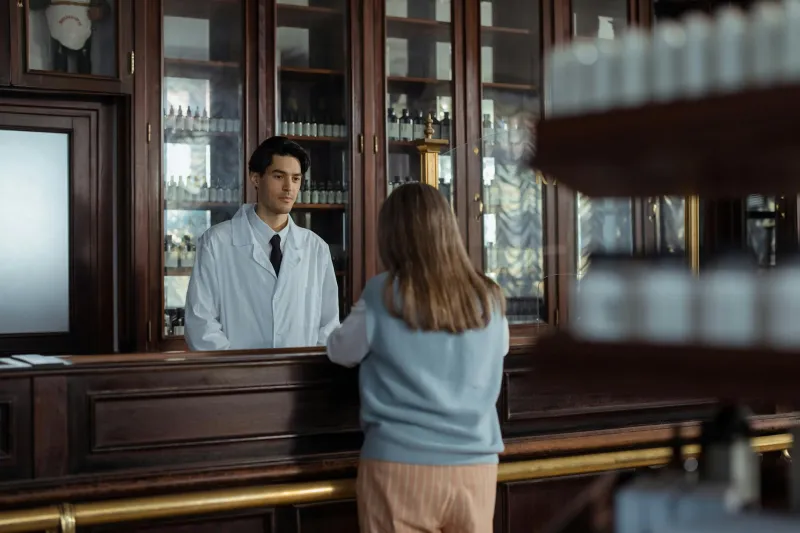
In 1970, most Americans filled their prescriptions at independently-owned corner pharmacies. The pharmacist behind the counter wasn't just a pill dispenser; he was often a trusted healthcare advisor who had served the same families for decades. These weren't corporate employees rotating between locations—they were neighborhood fixtures who understood that medicine was as much about relationships as it was about prescriptions.
The Era of Handwritten Records and Personal Memory
Before computerized databases tracked every medication interaction, pharmacists relied on handwritten patient files and, more importantly, their own memory. A good pharmacist could recite your medication history from memory, knew which drugs didn't agree with you, and could spot potential problems before they happened. They maintained detailed index cards for each customer, noting not just prescriptions but also allergies, preferences, and family medical histories.
This personal knowledge extended beyond the technical. Your pharmacist knew that Mrs. Johnson from Oak Street couldn't afford her blood pressure medication every month, so he'd work with her doctor to find samples or generic alternatives. He knew that teenage Tommy was probably buying those cough syrups for the wrong reasons and would have a quiet word with his parents. The corner pharmacy was as much a community health center as it was a business.
When Advice Came Free with Every Prescription
In the pre-internet age, pharmacists served as accessible medical advisors. They answered questions about drug interactions, explained how to properly take medications, and offered guidance on over-the-counter remedies. Many customers would consult their pharmacist before bothering their doctor with minor health concerns. This wasn't just customer service—it was an essential part of community healthcare, especially in smaller towns where the nearest doctor might be miles away.
The relationship was built on trust and continuity. Families would stick with the same pharmacist for generations, creating a medical history that lived in one person's memory and filing system. When your pharmacist had known your family for twenty years, he could spot changes in your health patterns and medication needs that might escape notice in today's fragmented healthcare system.
The Corporate Revolution Changes Everything
The transformation began in earnest during the 1980s and 1990s as chain pharmacies expanded rapidly across America. CVS, Walgreens, and Rite Aid began acquiring independent pharmacies and implementing standardized systems designed for efficiency and profit. What followed was a complete reimagining of how Americans interacted with their medications.
Computer systems replaced handwritten files, bringing unprecedented accuracy in tracking prescriptions and identifying drug interactions. Automated dispensing machines reduced human error and increased speed. Drive-through windows eliminated the need to even enter the store. These changes brought real benefits: fewer medication errors, faster service, and 24-hour availability at many locations.
The Digital Age of Anonymous Efficiency
Today's pharmacy experience prioritizes speed and accuracy over personal relationships. Prescription management apps let you refill medications without speaking to anyone. Automated phone systems handle routine inquiries. Many prescriptions are filled by pharmacy technicians rather than licensed pharmacists, who often work behind the scenes reviewing orders and handling complex cases.
The average chain pharmacy fills hundreds of prescriptions daily, making it impossible for staff to develop personal relationships with customers. Pharmacists today are highly trained clinical professionals, often with advanced degrees, but their expertise is channeled through corporate protocols rather than personal relationships. They catch dangerous drug interactions that might have been missed decades ago, but they're unlikely to remember your name or ask about your grandchildren.
What We Gained and What We Lost
Modern pharmacy practice has undoubtedly improved medication safety. Computer systems catch drug interactions that even the most experienced pharmacist might miss. Standardized procedures reduce errors, and regulatory oversight ensures consistent quality. Many chain pharmacies offer clinical services like vaccinations and health screenings that weren't available at corner drugstores.
But something quieter was lost in this transformation—the sense that someone in your community was actively watching over your health. The corner pharmacist served as an early warning system for health problems, a medication counselor, and sometimes the only healthcare professional that elderly or isolated patients saw regularly. That level of personal attention simply isn't scalable in today's high-volume pharmacy environment.
The Human Element in Healthcare
The evolution of American pharmacy reflects broader changes in healthcare—more scientific, more efficient, but also more impersonal. While we've gained precision and safety, we've lost the comfort of knowing that someone familiar was keeping track of our health. In an age of increasingly complex medical systems, the corner pharmacist represented something valuable: healthcare with a human face, delivered by someone who knew your story.
Today, your prescription is probably more accurate than ever before, filled faster than your grandfather could have imagined, and tracked by systems that would have seemed like science fiction fifty years ago. But somewhere in the pursuit of efficiency, we stopped expecting our pharmacist to remember our name—and perhaps forgot to ask whether that trade-off was entirely worth it.