The Shirt Your Grandfather Owned for Fifteen Years and the Forty-Three Shirts You Can't Quite Remember Buying
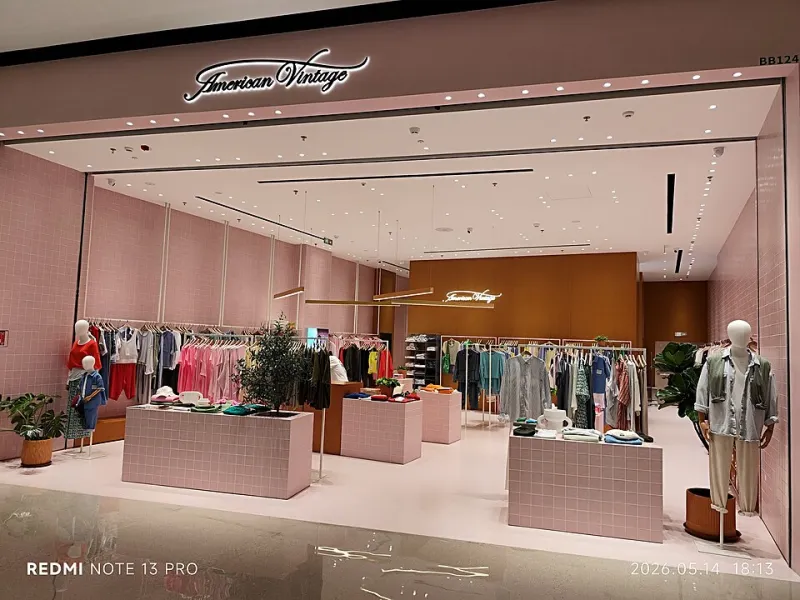
Photo: TWS LUOK Mingaowpuo, CC0, via Wikimedia Commons
The Shirt Your Grandfather Owned for Fifteen Years and the Forty-Three Shirts You Can't Quite Remember Buying
There's a particular kind of photograph that turns up in American family albums from the 1950s and 1960s — the kind where you can identify a man's favorite shirt across a decade of pictures. Same collar. Same pattern. Different occasions, different years, same shirt. He's wearing it at a barbecue in 1954 and again at a birthday party in 1961. It's faded slightly. It fits him exactly.
That shirt probably cost him the equivalent of a few hours' wages. He bought it once. He wore it until it couldn't be worn anymore. If it tore, someone in the house repaired it.
Now think about the last item of clothing you bought. Can you remember where it is?
How Americans Used to Get Dressed
Clothing was not always a disposable category. For most of American history, it was a considered purchase — one that reflected both economic reality and a different cultural relationship with objects.
In the mid-20th century, American garment manufacturing was largely domestic. Factories in New York, the Carolinas, and Pennsylvania produced clothing under union contracts that set minimum wages and quality standards. The economics of that system meant clothes cost more relative to income than they do today — but they were also built to last. Cotton was heavier. Stitching was denser. Zippers were metal.
A working-class family in 1955 might budget carefully for a new winter coat, buy it in September, and expect it to last five to seven years. Children's clothing was bought slightly large so it could be grown into. When a garment wore thin at the elbows or knees, it was patched. When it was genuinely beyond repair, it was repurposed — as a rag, as a quilt square, as something.
Nothing was wasted because nothing was cheap enough to waste.
The Manufacturing Migration That Changed the Math
The transformation of American clothing culture has a fairly precise origin point: the collapse of domestic garment manufacturing beginning in the 1970s and accelerating through the 1980s and 1990s.
As trade agreements opened global markets and brands discovered they could produce garments in Bangladesh, Vietnam, and Cambodia for a fraction of what domestic factories charged, the economics of clothing flipped entirely. A T-shirt that cost $18 in 1978 — real money — became a $6 item by 2005. Adjusted for inflation, clothing is roughly 40 percent cheaper today than it was in the early 1990s, according to the Bureau of Labor Statistics.
The domestic industry didn't survive the transition. Employment in American apparel manufacturing fell from around 900,000 workers in 1990 to fewer than 100,000 today. The knowledge, the infrastructure, and the quality benchmarks those workers maintained largely went with them.
What replaced them was a global supply chain optimized for volume and speed, not durability. Fast fashion — the business model pioneered by retailers like Zara and H&M and since adopted by an entire digital ecosystem of ultra-cheap brands — is built on the premise that clothes are not investments. They are experiences. You wear them a few times, they lose their shape or fall out of trend, and you replace them.
The Numbers That Should Give You Pause
The scale of what this shift produced is genuinely difficult to absorb.
The average American now buys approximately 68 items of clothing per year, according to research from the American Apparel and Footwear Association. That's more than one new garment per week. The average item of clothing is worn just seven times before being discarded. Americans throw away roughly 81 pounds of textiles per person annually — the vast majority of which ends up in landfills, since only about 15 percent of discarded clothing is donated or recycled.
The clothing industry globally is responsible for an estimated 10 percent of annual carbon emissions — more than aviation and shipping combined. The dyeing and treatment of textiles is one of the largest sources of water pollution worldwide. The synthetic fibers that dominate fast fashion — polyester, nylon, acrylic — shed microplastics with every wash cycle, entering waterways and eventually the food chain.
Your grandfather's shirt, worn for fifteen years and eventually used as a shop rag, had an environmental footprint so small by comparison it barely registers.
What Clothing Used to Mean
Beyond the environmental math, there's a cultural dimension to this shift that's harder to quantify but equally real.
When clothing was expensive and durable, it carried meaning. A good suit was saved for. A pair of quality work boots was broken in over years and associated with specific memories. Clothes marked occasions — not because people were more formal, but because buying something new was itself an occasion.
That meaning has been almost entirely drained from the modern clothing purchase. When a shirt costs $12 and arrives in a poly mailer two days after you clicked a button at midnight, it doesn't mean anything. It's not even really a decision. It's a reflex.
The irony is that despite buying more clothing than any previous generation, many Americans report feeling like they have nothing to wear. The abundance hasn't produced satisfaction. It's produced a closet full of things that don't quite fit, don't quite work, and don't quite matter.
The Quiet Pushback
There are signs that something is shifting. The resale market for clothing — driven by platforms like ThredUp, Poshmark, and The RealReal — has grown dramatically, projected to reach $350 billion globally by 2028. A younger generation of consumers has shown genuine interest in vintage clothing, in brands that publish supply chain information, in buying less and buying better.
Whether that represents a genuine cultural correction or a niche market running alongside an otherwise unchanged system of mass consumption remains to be seen.
But somewhere, in a closet that's never been photographed, there's probably still a shirt that's been around long enough to tell a story. That used to be the whole point.