The Encyclopedia Knew What It Knew. The Internet Knows Everything — and That's the Problem.
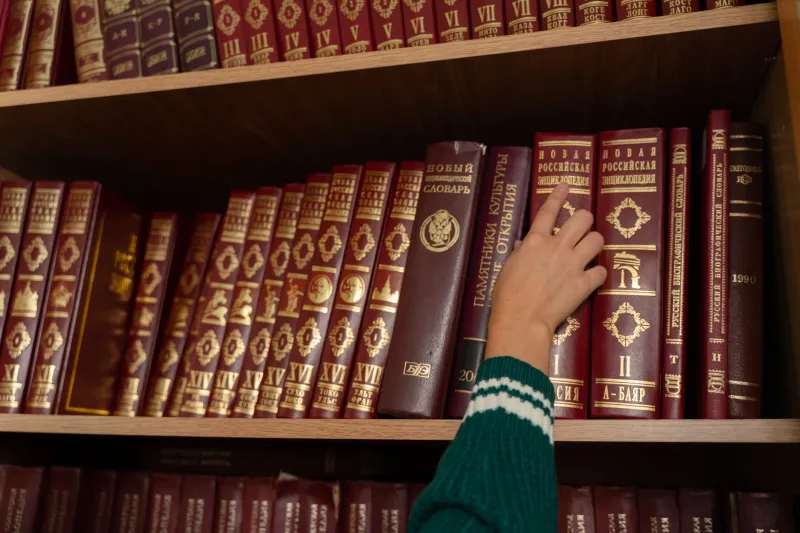
Somewhere in a storage unit or a parent's basement, there's probably a set of Encyclopedia Britannica collecting dust. Twenty-four volumes, dark spines, gold lettering. Maybe a World Book set if the family bought American. They were heavy, slightly formal, and occasionally out of date by the time they arrived. They were also, in a way that's hard to fully appreciate now, deeply trustworthy.
Nobody argued about whether the encyclopedia's entry on photosynthesis was biased. Nobody scrolled to the comments section to see if other readers thought the information on the French Revolution had an agenda. You looked it up, you read it, and that was more or less the end of the inquiry.
We live in a fundamentally different information world now — and the change has been so rapid that most of us haven't stopped to reckon with what we've actually gained and lost.
A Limited Menu, Served With Confidence
Think about how a curious American household navigated questions in, say, 1975. You had the encyclopedia. You had the local library, staffed by an actual librarian who knew where things were. You had a small number of television news broadcasts — Cronkite, then Rather, Brokaw, Jennings — delivered at a fixed time each evening with a shared sense of civic authority. You had the newspaper, probably one, probably local.
That sounds like deprivation compared to today. But consider what that scarcity produced: a relatively shared sense of what was true. The sources were limited enough that most people in a community were drawing from the same wells. A fact was a fact because the encyclopedia said so, or because the librarian helped you find it in a reference book, or because Walter Cronkite said it on the evening news.
The gatekeeping was real, and it came with genuine flaws — important perspectives were excluded, powerful institutions were sometimes protected, the full complexity of history was often flattened. None of that should be romanticized. But the system produced something valuable that we've largely lost: a baseline shared reality that made it possible for people to disagree about what to do about facts without first arguing about what the facts were.
When the Floodgates Opened
The internet didn't arrive with a warning label. It arrived as a miracle — and in many respects it still is one. The democratization of publishing, the collapse of geographic barriers to information, the ability to access primary sources that once required a university library card: these are genuine achievements. A first-generation college student in rural Mississippi can now access research papers that would have been invisible to her parents' generation. That matters enormously.
But the same infrastructure that enabled that access also enabled something else: the complete collapse of editorial standards as a prerequisite for reaching a mass audience. Anyone can publish anything. A peer-reviewed study and a fabricated statistic sit side by side in search results with no visual distinction between them. A fringe theory that would once have circulated in a photocopied newsletter can now reach millions of people by Tuesday morning.
And then the algorithms arrived to make it worse. The platforms that now mediate most Americans' information consumption are not optimized for accuracy. They're optimized for engagement — which, it turns out, tends to mean outrage, novelty, and confirmation of existing beliefs. The encyclopedia didn't know what you wanted to hear. Your feed absolutely does.
The Paradox of Knowing More and Trusting Less
Here's what's genuinely strange about the current moment: we have access to more verified, high-quality information than any generation in human history, and yet surveys consistently show that Americans trust institutions, experts, and media at historic lows. We are simultaneously more informed and more uncertain than our grandparents were.
Part of this is the sheer volume. The human brain wasn't built to process the quantity of information that now arrives through a smartphone every day. Cognitive overload is real — when you're exposed to twenty conflicting claims about the same topic before breakfast, the rational response isn't to carefully evaluate each one. It's to either pick the one that feels right or disengage entirely.
Part of it is the adversarial nature of modern information. Because anyone can publish and anyone can profit from attention, there are now entire industries built around manufacturing doubt, exploiting confusion, and making settled questions look unsettled. Climate science, vaccine safety, basic historical events — topics that were once simply matters of established fact have been deliberately muddied by coordinated campaigns that use the openness of the internet as a weapon.
What We Actually Looked Like, Looking Things Up
There's something almost meditative about the image of a kid in the 1970s pulling a volume off the shelf, flipping to the right page, and reading an entry about, say, the Amazon River. The information was finite. The rabbit hole had a bottom. You learned what you came to learn and you put the book back.
Now that same kid — grown up, holding a phone — types the same question and gets 4.7 million results in 0.4 seconds. Somewhere in those results is an excellent answer. Also several misleading ones, a few that are outright false, some that are technically accurate but wildly out of context, and at least one that will make them angry about something unrelated before they've found what they were looking for.
The encyclopedia was a closed system. The internet is an open one. Open systems have enormous advantages — but they also require the user to do something the encyclopedia never asked of them: figure out who to believe.
That's a skill most of us are still learning. And it turns out it's a lot harder than pulling a book off a shelf.