She Fed the Whole Table for What You Spent on Lunch Yesterday
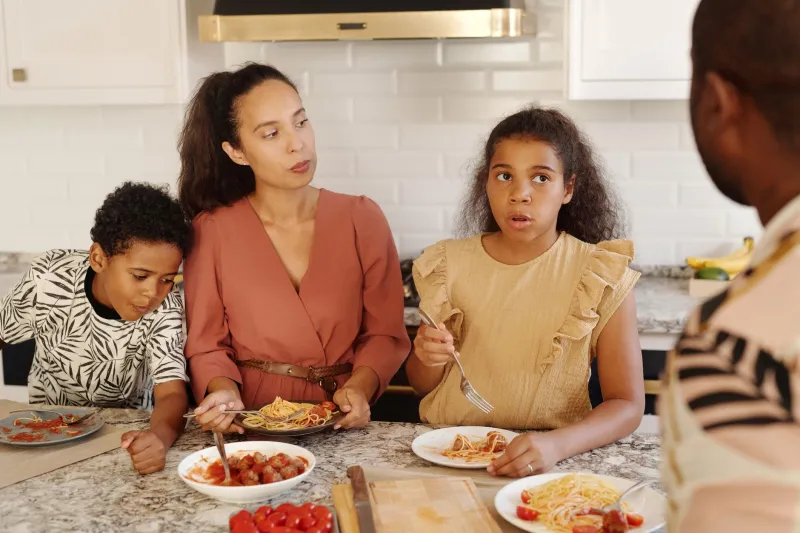
There's a photograph a lot of American families have somewhere — in a shoebox, on a wall, scanned and forgotten in a cloud folder. A kitchen table. A big one. Six or eight or ten people seated around it, some of them kids, some of them clearly just neighbors who showed up. And in the middle of that table, enough food to silence everyone for a while.
That meal was probably built on a budget that would embarrass a modern grocery receipt. And the woman who made it — because it was almost always a woman, which is a separate conversation — did it without a single delivery app, a meal kit subscription, or a $14 jar of artisan pasta sauce.
She just knew how to cook. And she knew that nothing went to waste.
The Economics of the Mid-Century Kitchen
In 1955, the average American household spent about 30 percent of its income on food. That sounds like a lot — and it was, relative to wages — but the way that money was spent tells a different story than the number alone suggests.
Groceries were bought whole. A chicken was a chicken, not a shrink-wrapped tray of pre-portioned boneless thighs. You bought the bird, you roasted it Sunday, you made sandwiches Monday, you turned the carcass into stock Tuesday, and you built a soup around that stock Wednesday. One purchase, four meals. The math was taught, not learned from a YouTube channel.
Roasts became hash. Stale bread became stuffing or breadcrumbs. Vegetable scraps went into the pot. Lard was saved in a coffee can on the stove. The concept of throwing away food that was still edible — in any form — was genuinely foreign to households that had lived through the Depression and the rationing of the war years. Waste wasn't a moral failing. It was a practical impossibility.
A family of six could eat for a week on $15 to $20 in the mid-1950s. Adjusted for inflation, that's roughly $170 today. The average American household now spends over $400 a week on food — and that figure includes a significant chunk spent on meals consumed outside the home, which represents far less volume per dollar than anything cooked from scratch.
The Convenience Premium
Somewhere in the 1970s and accelerating hard through the 1980s, the food industry made a bet. It bet that Americans would pay extra — sometimes dramatically extra — to have the cooking done for them. And it was right.
The frozen dinner, the canned soup, the boxed pasta kit, the drive-through window: each of these was sold as a time-saver, which in a household where both adults now worked full time, it genuinely was. Nobody was wrong to want convenience. The economics of the household had changed. Time was the scarce resource now, not money.
But the trade was more expensive than it looked on the label.
Today, a fast-casual lunch for one in an American city — a burrito bowl, a sandwich combo, a salad with protein — routinely runs $15 to $20 before tip. A DoorDash delivery of that same meal adds another $8 to $12 in fees and delivery charges. That's a single lunch for one person at a cost that would have fed a mid-century family of four for two days.
The convenience premium is real, it compounds daily, and most people absorb it without doing the math.
What Got Lost in the Handoff
The shift away from scratch cooking wasn't just financial. It carried nutritional consequences that took decades to fully surface.
The mid-century American diet had serious problems — too much saturated fat, not enough vegetables by modern standards, and a heavy reliance on white bread and canned goods. Nobody is arguing for a wholesale return to the 1955 table. But the food was, by and large, food. Recognizable ingredients, combined by hand, without the sodium loads and additive lists that define most processed products today.
Ultra-processed foods — a category that includes most packaged snacks, frozen meals, fast food, and convenience items — now account for roughly 60 percent of the calories Americans consume. Research linking these products to obesity, cardiovascular disease, and metabolic disorders has accumulated steadily over the past two decades. The convenience we bought in the 1980s is presenting its invoice now, and it's not just financial.
The grandmother who made soup from bones wasn't just being thrifty. She was, without knowing the terminology, practicing a form of whole-food cooking that modern nutritionists spend careers trying to promote.
The Knowledge That Didn't Get Passed Down
Perhaps the most significant thing lost in the transition wasn't the time or the money. It was the skill.
Cooking knowledge used to move through families the way language does — absorbed in childhood, refined through repetition, passed down without ceremony. You learned to make biscuits because you watched your mother make them every Saturday morning for ten years. You learned to break down a chicken because it was cheaper than buying parts and your grandmother showed you once and expected you to remember.
That transmission largely stopped. Home economics was dropped from most school curricula. Families stopped cooking together as schedules fractured. The knowledge that took generations to accumulate didn't get handed to the generation that grew up on Hot Pockets and delivery pizza.
The result is a generation of adults who are, by historical standards, functionally illiterate in the kitchen — not through any fault of their own, but because nobody taught them and the food system made it easy not to learn.
The Table Is Still There
None of this means the mid-century kitchen was paradise. It was built on unpaid labor, limited options, and the expectation that women would perform domestic work as a matter of course. Romanticizing it wholesale would be dishonest.
But the underlying discipline — the idea that food is a resource to be respected, that skills compound over time, that cooking for yourself is almost always cheaper and often healthier than paying someone else to do it — that part holds up.
Your great-grandmother fed ten people on what you spent at Sweetgreen yesterday. She wasn't magic. She just knew something that didn't get written down before it disappeared.